Minneapolis Millers: Base Ball in the Flour City
Ghost League Archive: FILE 0002
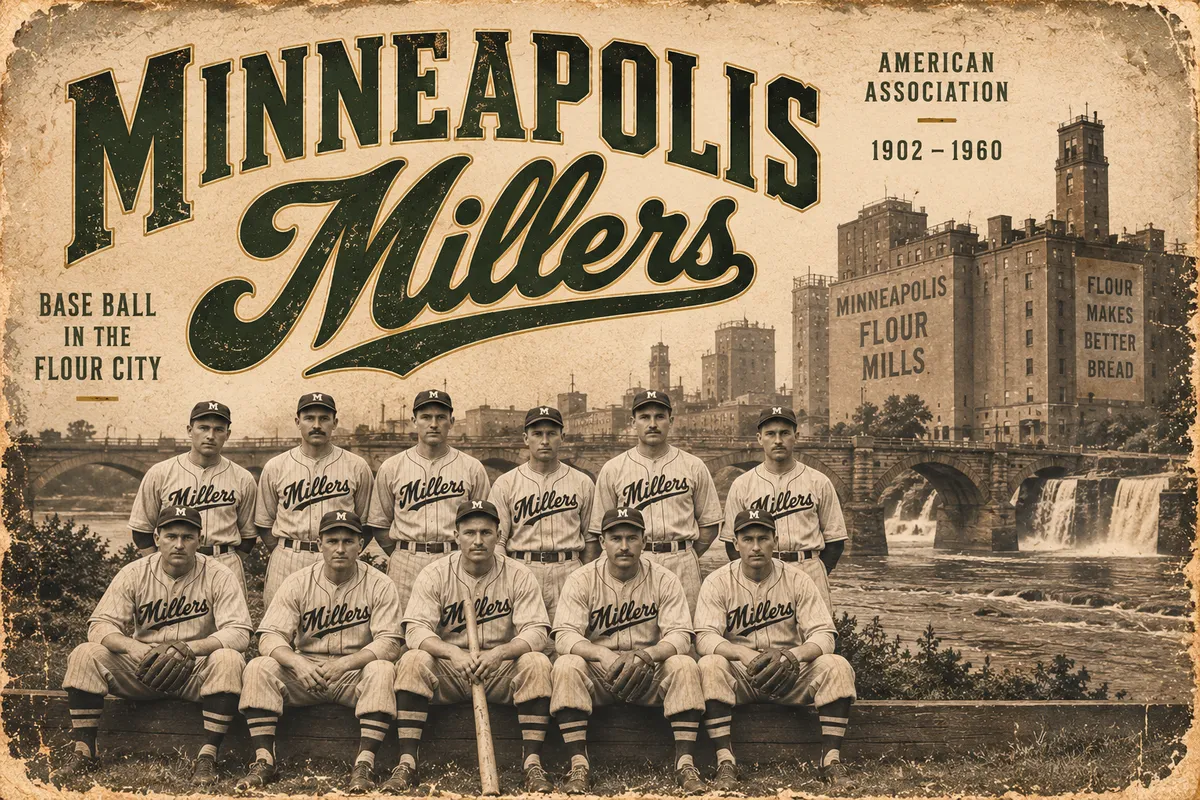
MINNEAPOLIS MILLERS
Minneapolis, Minnesota • American Association • 1902–1960

A Ball Club Built in the Flour City
Before the Twins brought Major League Baseball to Minnesota, Minneapolis already had a ball club generations of fans could call their own.
They were the Minneapolis Millers.
The name was perfectly suited to the city they represented. Minneapolis rose to prominence as one of the world's great flour-milling centers, its mills powered by the falls of the Mississippi River. The city's ball club carried that industrial identity onto the diamond.
Teams using the Millers name appeared in Minneapolis as far back as the nineteenth century, but the most enduring version arrived with the formation of the American Association in 1902.
For the next 59 seasons, the Millers became one of the Association's defining franchises.
They won nine American Association championships, developed future major-league stars and built a fierce cross-town rivalry with the St. Paul Saints.
Long before Minnesota had a major-league club, the Millers made Minneapolis a baseball town.
THE ARCHIVE RECORD
Club: Minneapolis Millers
Location: Minneapolis, Minnesota
League: American Association
Years: 1902–1960
Championships: 9 American Association titles
Home Grounds: Nicollet Park; later Metropolitan Stadium
Notable Rival: St. Paul Saints
Sport: Base Ball
BASE BALL IN THE FLOUR CITY
The Millers name was more than a catchy nickname.
By the late nineteenth and early twentieth centuries, Minneapolis had become synonymous with flour. Massive mills operated along the Mississippi River, helping earn Minneapolis the nickname “Flour City.”
Calling its ball club the Millers connected the team directly to the people and industry of the city.
And Minneapolis embraced them.
For much of their history, the Millers played at Nicollet Park, an intimate neighborhood ballpark that became one of the city's great sporting landmarks.
Just across the river, however, another American Association club was building its own following.
The St. Paul Saints.
The two clubs became natural rivals. Minneapolis and St. Paul were neighboring cities with separate identities, and their baseball teams gave residents another reason to argue over which side of the river was superior.
For decades, Millers-Saints games were a fixture of Twin Cities baseball.
THE SLUGGERS OF NICOLLET PARK
Nicollet Park could be particularly inviting to left-handed power hitters because of its short right-field dimensions.
Few players took greater advantage than Joe Hauser.
Known as “Unser Choe,” Hauser arrived in Minneapolis for the 1932 season and immediately began launching baseballs over fences.
He hit 49 home runs in 1932.
Then he did something extraordinary.
In 1933, Hauser hit 69 home runs in 154 games, establishing an American Association record and producing one of the great power-hitting seasons in minor-league history.
He wasn't alone.
The 1932 Millers hit 188 home runs, setting an American Association record while winning 100 games and capturing the league pennant.
The Millers repeated as champions in 1934 and again in 1935, creating one of the strongest stretches in franchise history.
FUTURE LEGENDS IN MINNEAPOLIS
One of the remarkable things about the Millers is the number of future baseball legends who wore the Minneapolis uniform.
Ted Williams played for the Millers in 1938 before becoming one of the greatest hitters in Major League history.
Willie Mays arrived in Minneapolis in 1951 as a 20-year-old prospect in the New York Giants organization. His stay was brief. His talent made it obvious that the minor leagues would not hold him for long.
Less than two months into the season, Mays was headed for New York.
Another future Hall of Famer, Carl Yastrzemski, played for Minneapolis in 1960 on his way to becoming a Boston Red Sox legend.
For Minnesota baseball fans, it meant that some of the greatest players the sport would ever know passed through their city before the rest of America knew what they would become.
WHAT HAPPENED TO THE MILLERS?
By the end of the 1950s, baseball in Minnesota was changing.
The Millers left Nicollet Park after the 1955 season and moved to the new Metropolitan Stadiumin Bloomington.
But something much larger was coming.
Major League Baseball was preparing to arrive in Minnesota.
After the 1960 season, the Washington Senators relocated to the Twin Cities and became the Minnesota Twins.
With a major-league franchise moving into Metropolitan Stadium, there was no longer a place for Minneapolis' longtime American Association club.
The Millers' run came to an end after the 1960 season.
Nearly six decades of American Association baseball were over.
But the Millers had already built a remarkable legacy.
Nine league championships.
Generations of Minneapolis baseball fans.
A rivalry that helped define Twin Cities sports.
And a roster that, over the years, included some of the greatest names the game would ever know.
Before there were Twins in Minnesota, there were Millers in Minneapolis.
And they belong in the Archive.
Click here to view our Minneapolis Millers merchandise
GHOST LEAGUE ARCHIVE
Forgotten Teams. Unforgettable Legacy.
HISTORICAL NOTE:
Ghost League Supply Co. researches each Archive entry using available historical records and sources. Because many early teams were poorly documented, dates, records, names and other details may vary between sources.
Some images and artwork appearing in the League Archive are AI-assisted historical interpretations created for illustrative purposes and should not be considered authentic photographs, official team artwork or exact historical reconstructions.