Fort Dodge Gypsum Eaters: Base Ball in Gypsum City
Ghost League Archive: FILE 0003
FORT DODGE GYPSUM EATERS
Fort Dodge, Iowa • Iowa State League • 1904

A Name Only Fort Dodge Could Have
Base ball history is filled with strange nicknames.
Few are quite like the Fort Dodge Gypsum Eaters.
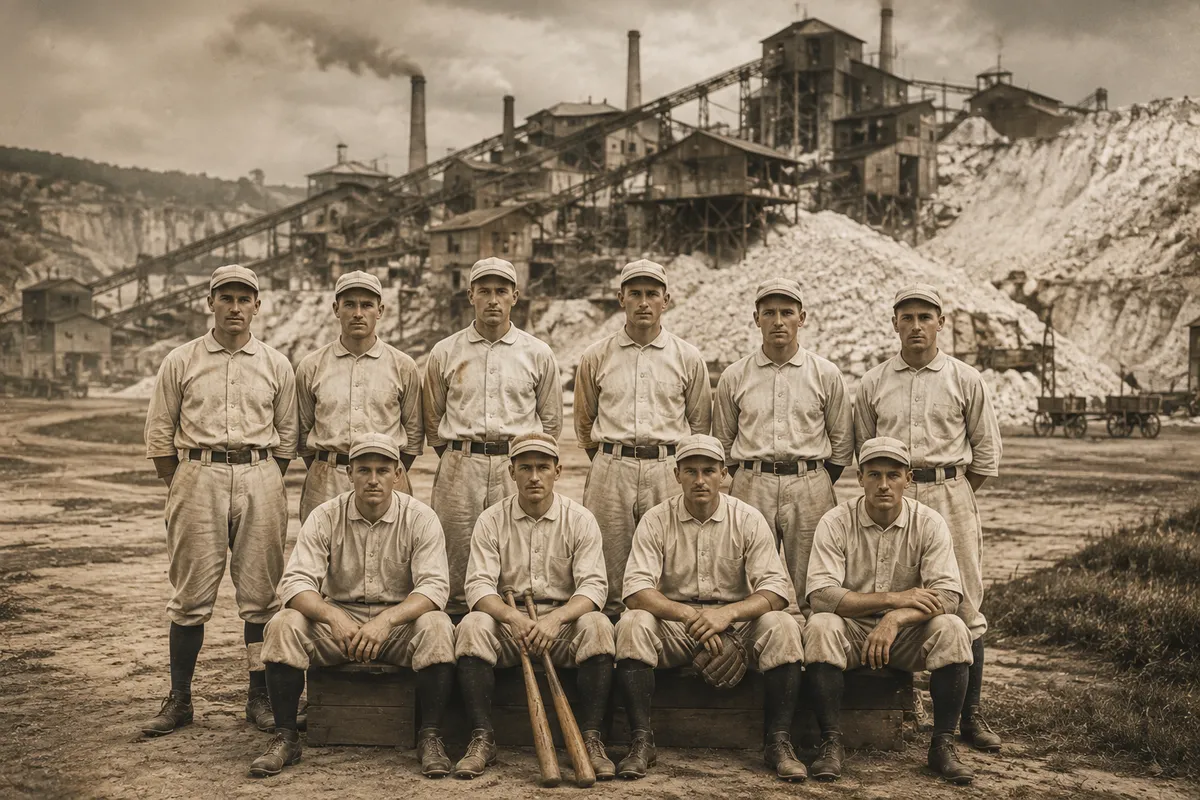
The name wasn't dreamed up as a joke. It came directly from the industry that helped define Fort Dodge, Iowa.
Beneath the region were enormous deposits of gypsum, a mineral quarried and processed for products ranging from plaster to building materials. As the industry grew, gypsum became inseparable from the identity of Fort Dodge.
So when professional base ball arrived in town in 1904, the city's new club carried that identity onto the diamond.
They became the Gypsum Eaters.
For one season, one of the most unusual names in early professional base ball belonged to Fort Dodge.
THE ARCHIVE RECORD
Club: Fort Dodge Gypsum Eaters
Location: Fort Dodge, Iowa
League: Iowa State League
Year: 1904
Record: 57–52
Finish: 5th
Manager: Frank Boyle
Season Attendance: 13,582
Affiliation: Independent
Sport: Base Ball
BASE BALL IN GYPSUM COUNTRY
Fort Dodge's connection to gypsum made the nickname much less peculiar to the people who actually lived there.
Gypsum mining and manufacturing were important parts of the local economy, making an industry-inspired ball club name perfectly at home in an era filled with teams named for the occupations and products of their communities.
The Gypsum Eaters joined the newly organized Iowa State League in 1904.
Their competition had names nearly as colorful as their own.
There were the Boone Coal Miners, Burlington River Rats, Waterloo Microbes, Oskaloosa Quakers, Ottumwa Snappers, Marshalltown Grays and Keokuk Indians.
It was early minor-league base ball at its finest: local clubs carrying the personalities of their towns from one Iowa ballpark to another.
THE 1904 SEASON
Under manager Frank Boyle, Fort Dodge put together a winning first season.
The Gypsum Eaters finished 57–52, good for fifth place in the eight-team Iowa State League.
They finished behind Ottumwa, Waterloo, Marshalltown and Keokuk but comfortably above Boone, Oskaloosa and Burlington.
The season drew a reported 13,582 fans to Fort Dodge home games—roughly 249 spectators per home date.
It was modest by today's standards.
But in a city of roughly 13,000 people at the beginning of the twentieth century, several hundred people gathering to watch their local nine was part of a growing base ball culture spreading through towns across the Midwest.
And Fort Dodge had proven it could support a professional club.
FROM GYPSUM EATERS TO GYPSUMITES
The strangest part of the Gypsum Eaters story may be how quickly the name disappeared.
Before the 1905 season, Fort Dodge held a contest to choose a new name for the club.
More than 30 suggestions were reportedly submitted.
The winner was Gypsumites, a name proposed by L.A. Thorson and praised at the time as both appropriate and unique to Fort Dodge.
The connection to the city's defining industry remained.
The “Eaters” did not.
The newly renamed Gypsumites went on to have an excellent 1905 season, finishing 73–49 and taking second place in the Iowa State League.
They returned again in 1906, finishing 68–49 in third place.
Then the franchise disappeared from the league.
The name Gypsum Eaters had lasted just one season.
WHAT HAPPENED TO FORT DODGE BASE BALL?
Professional base ball eventually returned to Fort Dodge.
The city fielded the Fort Dodge Boosters in 1912 and later the Fort Dodge Dodgers in 1916 and 1917.
But none carried a name quite like the club that started it all.
The Gypsum Eaters existed for only a brief moment in 1904.
A winning team.
A town built around an industry.
And a nickname so unusual that more than a century later it still demands an explanation.
That's exactly the kind of team the Ghost League Archive was built to remember.
Click here to view our Gypsum Eaters merchandise
GHOST LEAGUE ARCHIVE
Forgotten Teams. Unforgettable Legacy.
HISTORICAL NOTE:
Ghost League Supply Co. researches each Archive entry using available historical records and sources. Because many early teams were poorly documented, dates, records, names and other details may vary between sources.
Some images and artwork appearing in the League Archive are AI-assisted historical interpretations created for illustrative purposes and should not be considered authentic photographs, official team artwork or exact historical reconstructions.