The Flint Vehicles: Baseball from the City That Put America on Wheels
Ghost League Archive: FILE 0004
FLINT VEHICLES
Flint, Michigan • Interstate Association / Southern Michigan League / Michigan-Ontario League • 1906–1926

A Ball Club Built in the Automobile City
Before automobiles became the defining symbol of Flint, Michigan, the city was already making a name for itself as an industrial powerhouse.
And as Flint transformed into one of America's great automobile-manufacturing centers, its baseball team carried a name that seemed perfectly suited to the moment.
They were the Flint Vehicles.
Not the Tigers. Not the Giants. Not the Eagles.
The Vehicles.
It sounds unusual today, but in the early twentieth century, when baseball clubs often borrowed their identities from local industries, the name made sense.
The Flint Vehicles first appeared in professional baseball records in 1906. Over the next two decades, the club would compete in several minor leagues, produce future major-league talent, and twice come tantalizingly close to championship glory.
They never became one of baseball's famous franchises.
But their story belongs to a city that helped put America on wheels.
THE ARCHIVE RECORD
Club: Flint Vehicles (also known as the Vehics)
Location: Flint, Michigan
Leagues:Interstate Association; Southern Michigan League; Michigan-Ontario League; Michigan State League
Years: 1906–1915; 1921–1926
Best Seasons: 1909 (72–52); 1924 (78–52)
Championships: No confirmed league championship during these seasons
Notable Players: Gene Krapp, Frank Luce, Art Jahn
Notable Rival: Bay City Wolves
BASE BALL IN THE AUTOMOBILE CITY
Flint's baseball story unfolded alongside one of the most dramatic industrial transformations in American history.
In the late nineteenth century, Flint was already known for producing carriages and other horse-drawn vehicles.
Then came the automobile.
Buick became a major force in the city, and William C. Durant organized General Motors in 1908. Factories expanded, workers arrived, and Flint became increasingly identified with the emerging motor industry.
Against that backdrop, a baseball team called the Vehicles seemed right at home.
Although the nickname clearly reflected the city's industrial character, the surviving records do not establish exactly who selected it or whether it was intended to represent a particular automobile manufacturer.
The earliest documented Flint Vehicles club competed in the Interstate Association in 1906.
That league folded in July, cutting the season short.
The following year, Flint joined the Southern Michigan League, beginning a longer chapter of professional baseball.
The early seasons were difficult.
Flint finished seventh in both 1907 and 1908.
But the Vehicles were about to turn things around.
THE PENNANT THAT GOT AWAY
In 1909, Flint suddenly became one of the strongest clubs in the Southern Michigan League.
Under manager Red Wright, the Vehicles compiled a 72–52 record.
It was an extraordinary improvement for a team that had finished near the bottom of the standings just one year earlier.
The championship race was remarkably close.
Saginaw finished 73–52.
Flint finished 72–52.
Jackson finished 71–52.
When the final standings were calculated, Flint had finished just half a game behind Saginaw.
A single victory might have changed the entire season.
Among the players who helped make the Vehicles competitive was pitcher Gene Krapp, who recorded 23 victories in 1909.
Krapp eventually reached the major leagues with Cleveland, demonstrating that even a relatively obscure Michigan minor-league club could develop players capable of competing at baseball's highest level.
The Vehicles did not win the pennant.
But for one season, Flint came remarkably close.
THE VEHICLES RETURN
The Southern Michigan League continued operating through the early years of the 1910s, with Flint remaining a regular competitor.
In 1911, the Vehicles finished 77–59, placing third.
But minor-league baseball was an uncertain business.
Teams struggled financially. Leagues reorganized. Franchises disappeared.
In July 1915, the Southern Michigan League disbanded before completing its season.
The Flint Vehicles disappeared with it.
Professional baseball eventually returned to the city in 1919 under a different name: the Flint Halligans.
The Halligans competed in the Michigan-Ontario League during 1919 and 1920.
Then, in 1921, Flint brought back its old baseball identity.
The Vehicles were rolling again.
This time, they were competing in a Class B league that included clubs from Michigan and Ontario, Canada.
And the second generation of Vehicles would produce some of the franchise's most memorable players.
THE SLUGGERS OF FLINT
One of the most interesting chapters in Vehicles history came during the early 1920s.
The club was owned by brothers Bill and Otto Powell. Bill was a former major-league pitcher, while Otto was involved in the automobile business.
Their connections helped bring talented players to Flint.
Among them was Art Jahn.
Jahn joined the Vehicles in 1923 after playing in the Dakota League and attracting the attention of the Pittsburgh Pirates.
He quickly became one of the Michigan-Ontario League's standout hitters.
In 1923, Jahn batted .345 in 132 games, hit 18 home runs, and accumulated 290 total bases.
His teammate Frank Luce was even more impressive at the plate, batting .382 that season.
Together, they gave Flint one of the most dangerous offensive combinations in the league.
Jahn returned in 1924 and continued hitting, batting .317 while leading the Vehicles in several offensive categories.
Luce also remained a major threat.
In 1924, he led the Michigan-Ontario League with 23 home runs.
For fans in Flint, the Vehicles were no longer simply a familiar local team.
They were legitimate contenders.
ONE GAME FROM GLORY
The 1924 season became one of the finest in Flint Vehicles history.
Managed by Dan O'Leary, the club finished 78–52.
That .600 winning percentage was good for second place in the Michigan-Ontario League.
Only the Bay City Wolves finished ahead of them.
But the season wasn't over.
Flint met Bay City in the league championship series.
The two clubs battled through seven games.
Bay City won four.
Flint won three.
One game separated the Vehicles from a league championship.
For a team whose history included struggling seasons, interrupted leagues, and an earlier disappearance, 1924 represented a remarkable achievement.
Flint had come within one victory of winning it all.
Once again, however, the championship slipped away.
WHAT HAPPENED TO THE VEHICLES?
The Vehicles continued playing in the Michigan-Ontario League in 1925 and 1926.
But the minor-league landscape was changing again.
In June 1926, the Michigan-Ontario League merged with the Central League to form the Michigan State League.
The Flint franchise became part of that reorganization, and the old Vehicles identity disappeared from the city.
Flint would later field professional clubs under other names, including the Flint Gems and Flint Arrows.
But the Vehicles belonged to a particular moment in the city's history.
They had played during the rise of the automobile industry, when Flint was becoming a manufacturing center known across the country.
They had developed talented players.
They had nearly won pennants in 1909 and 1924.
And they had carried one of the most distinctive nicknames in early professional baseball.
Today, the Flint Vehicles are largely forgotten outside baseball history circles.
Their name may sound strange to modern fans.
But for the workers, families, and baseball followers of early twentieth-century Flint, it represented something familiar.
Their city.
Their industry.
Their ball club.
Long before baseball marketing departments invented elaborate mascots and identities, Flint had the Vehicles.
And they belong in the Archive.
Click here to view our Flint Vehicles merchandise
GHOST LEAGUE ARCHIVE
Forgotten Teams. Unforgettable Legacy.
HISTORICAL NOTE:
Ghost League Supply Co. researches each Archive entry using available historical records and sources. Because many early teams were poorly documented, dates, records, names and other details may vary between sources.
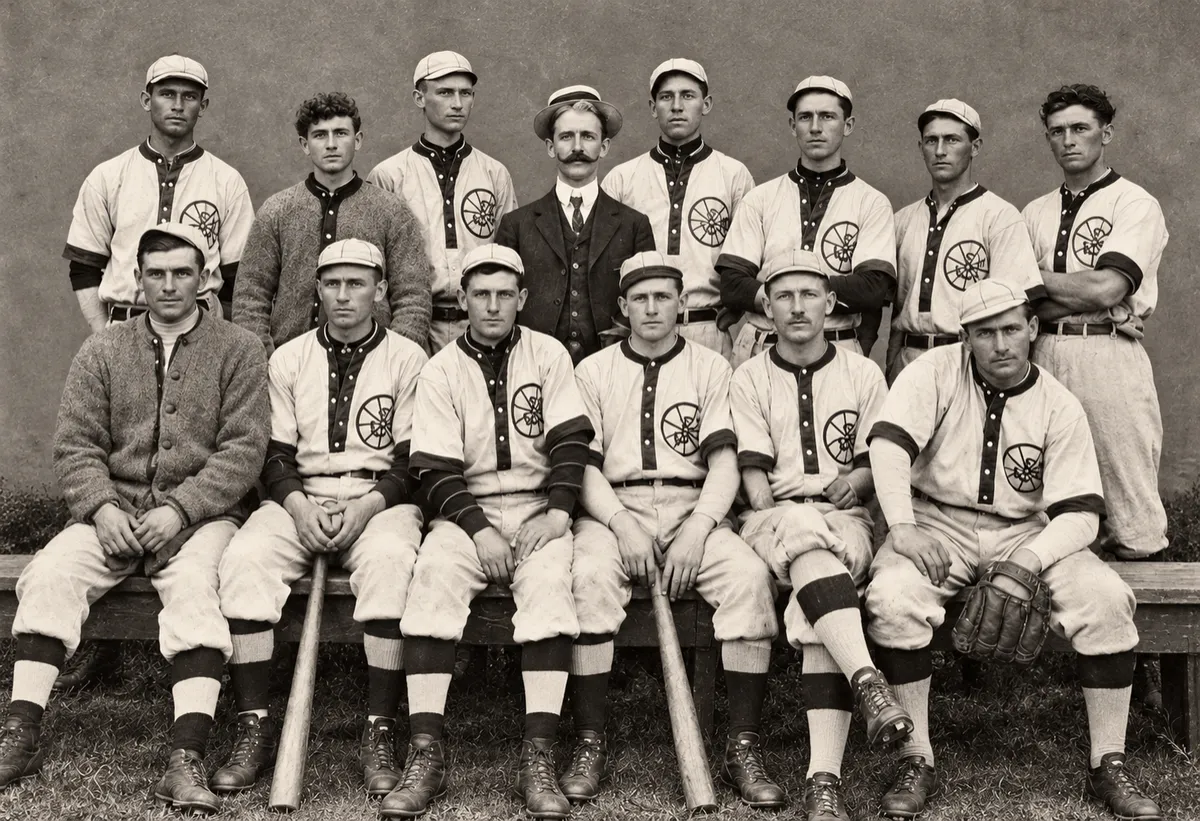
Some images and artwork appearing in the League Archive are AI-assisted historical interpretations created for illustrative purposes and should not be considered authentic photographs, official team artwork or exact historical reconstructions.