Portland Webfoots: The Forgotten Champions of the Northwest
Ghost League Archive: FILE 0005
PORTLAND WEBFOOTS
Portland, Oregon • Pacific Northwest League • 1901–1902

A CHAMPIONSHIP BEFORE THE BEAVERS
Before the Portland Beavers became one of the Pacific Coast League's most recognizable names, another ball club was making history in the Pacific Northwest.
They were the Portland Webfoots.
Their name reflected the rain-soaked character of Oregon, where wet weather was as much a part of everyday life as the rivers, forests and mountains surrounding the growing city.
The Webfoots arrived in 1901, when professional base ball was finding new opportunities in the expanding cities of the American West.
They played in a newly constructed ballpark, competed against clubs from Seattle, Tacoma and Spokane, and featured a young player who would eventually become one of the most famous shortstops in baseball history.
And in their very first season, they won the championship.
The Portland Webfoots existed for only two years.
But those two seasons helped establish the foundation for more than half a century of professional baseball at one of the Northwest's most beloved ballparks.
THE ARCHIVE RECORD
Club: Portland Webfoots
Location: Portland, Oregon
League: Pacific Northwest League
Years: 1901–1902
Championships: 1901 Pacific Northwest League
Home Grounds: Vaughn Street Park
Notable Player: Joe Tinker
1901 Record: 73–35
1902 Record: 58–62
BASE BALL COMES TO VAUGHN STREET
In 1901, Portland was growing into an important commercial center of the Pacific Northwest.
Railroads, shipping, lumber and manufacturing helped fuel the city's expansion.
Professional baseball was ready to grow alongside it.
That spring, a new ballpark was constructed near Northwest 24th Avenue and Vaughn Street.
It became known as Vaughn Street Park.
The grounds were financed by streetcar operators C. F. Swigert and E. I. Fuller, who recognized that a popular sporting attraction could bring both paying spectators and additional passengers to their streetcar lines.
On May 22, 1901, the park hosted its first professional baseball game.
Portland's new Webfoots had a home.
The original grounds were modest compared with the larger stadiums that would follow. But over the decades, Vaughn Street Park would become one of the city's great sporting landmarks.
Generations of fans would pass through its gates.
For the Webfoots, however, it was where everything began.
THE CHAMPIONS OF 1901
The Webfoots wasted little time proving they belonged.
Under manager John Grim, Portland dominated the four-team Pacific Northwest League during its inaugural season.
The competition included the Tacoma Tigers, Seattle Clamdiggers and Spokane Blue Stockings.
Portland finished with an impressive 73 victories against just 35 defeats.
Their .676 winning percentage put them 16 games ahead of second-place Tacoma.
The Webfoots were league champions.
The club's success was built on a strong pitching staff and a lineup that included several talented young players.
Pitchers Clyde Engle and Bill Salisbury each recorded 28 victories, while Joe Tinker contributed both offensive production and speed on the bases.
For a team playing its first season in a newly built ballpark, the results were remarkable.
Portland had a championship club.
And one of its young stars was about to become a household name.
BEFORE TINKER TO EVERS TO CHANCE
Among the players wearing a Portland uniform in 1901 was a young infielder from Kansas named Joe Tinker.
He was just 20 years old when the season began.
Playing third base for the Webfoots, Tinker appeared in 106 games and batted .290, collecting 123 hits.
He also stole 37 bases, tying for the league lead.
His performance attracted attention beyond the Pacific Northwest.
The following year, Tinker joined the Chicago Cubs, beginning a Major League career that would eventually earn him a place in the National Baseball Hall of Fame.
In Chicago, he became the shortstop in one of baseball's most celebrated defensive combinations.
Tinker to Evers to Chance.
The trio became immortalized in baseball folklore, their names forever connected to the Cubs teams of the early twentieth century.
Tinker helped Chicago win four National League pennants and back-to-back World Series championships in 1907 and 1908.
But before the championships, before the famous double plays and before Cooperstown, there was Portland.
There were the Webfoots.
And there was a young ballplayer developing his game on a brand-new diamond in Oregon.
A SECOND SEASON AND A CHANGING LEAGUE
The Webfoots returned for the 1902 season, but the championship success of their inaugural year proved difficult to repeat.
The Pacific Northwest League expanded to six clubs, adding teams from Butte and Helena, Montana.
With Sam Vigneux serving as manager, Portland finished with 58 victories and 62 defeats.
That was good for fourth place.
Meanwhile, larger changes were taking place throughout professional baseball in the West.
The California League and clubs from the Pacific Northwest were discussing a new organization that could bring together some of the region's largest baseball markets.
The proposed circuit would eventually become the Pacific Coast League.
Portland was part of those discussions, but the transition was far from simple.
Disagreements between club officials and league leadership created controversy over which teams would join the new organization and how the existing league would be affected.
By the end of 1902, the future of professional baseball in Portland was changing.
And the Webfoots name was nearing the end of its brief run.
WHAT HAPPENED TO THE WEBFOOTS?
When the Pacific Coast League began play in 1903, Portland entered the new circuit under a different name.
The Portland Browns.
The Webfoots name disappeared from the professional baseball landscape after just two seasons.
But the ballpark they helped establish remained.
Vaughn Street Park continued hosting professional baseball for more than five decades, eventually becoming closely associated with the Portland Beavers.
The grounds were expanded and rebuilt over the years, growing into a ballpark capable of accommodating thousands of spectators.
By the mid-1950s, the old park's time was coming to an end.
Professional baseball moved to a new stadium, and Vaughn Street Park was demolished in 1956.
Today, little remains of the old grounds beyond the historical record and a marker commemorating the site.
But the Webfoots' place in Portland baseball history is secure.
They were the first professional club to call Vaughn Street Park home.
They won the Pacific Northwest League championship in 1901.
They helped develop a future Hall of Famer.
And they were part of the transition that brought Portland into the Pacific Coast League era.
Two seasons.
One championship.
One future baseball legend.
Before the Browns, before the Beavers and before generations of fans filled Vaughn Street Park, there were the Portland Webfoots.
And they belong in the Archive.
EXPLORE OUR PORTLAND WEBFOOTS COLLECTION
GHOST LEAGUE ARCHIVE
Forgotten Teams. Unforgettable Legacy.
HISTORICAL NOTE:
Ghost League Supply Co. researches each Archive entry using available historical records and sources. Because many early teams were poorly documented, dates, records, names and other details may vary between sources.
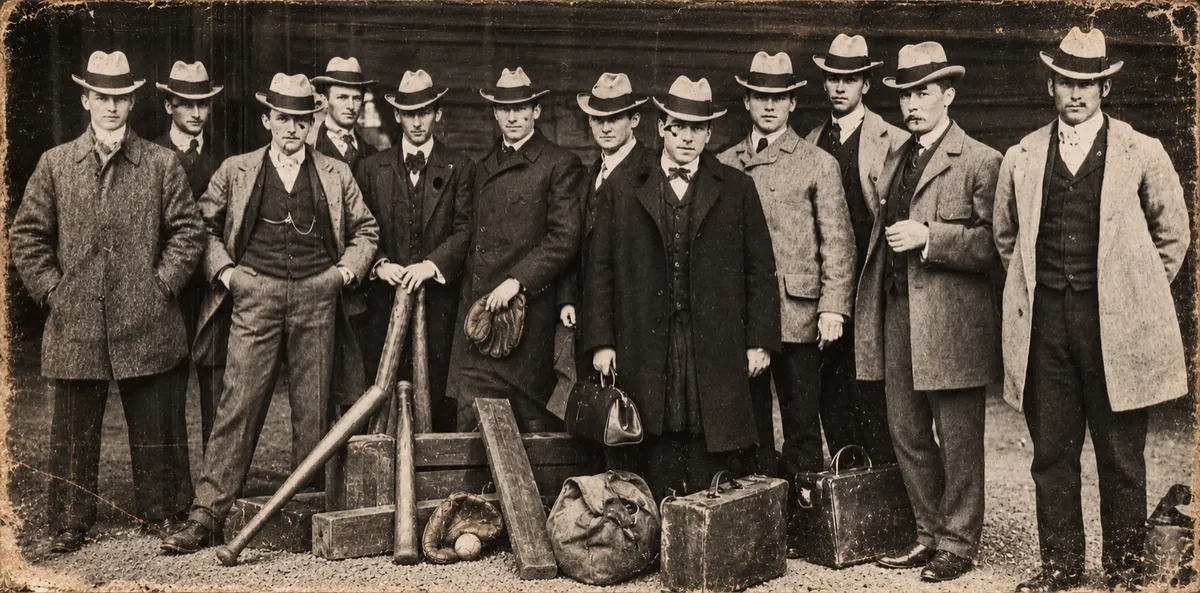
Some images and artwork appearing in the League Archive are AI-assisted historical interpretations created for illustrative purposes and should not be considered authentic photographs, official team artwork or exact historical reconstructions.