Dallas Hams: The First Champions of Texas Base Ball
Ghost League Archive: FILE 0006
DALLAS HAMS
Texas League & Texas-Southern League • 1888, 1890, 1892

THE TEAM THAT WON WHEN EVERYONE ELSE WAS QUITTING
Long before the Texas Rangers brought Major League Baseball to North Texas, a strangely named ball club was making history across the Trinity River from downtown Dallas.
They were the Dallas Hams.
Their name might sound more appropriate for a butcher shop than a baseball diamond, but there was nothing comical about the way they played.
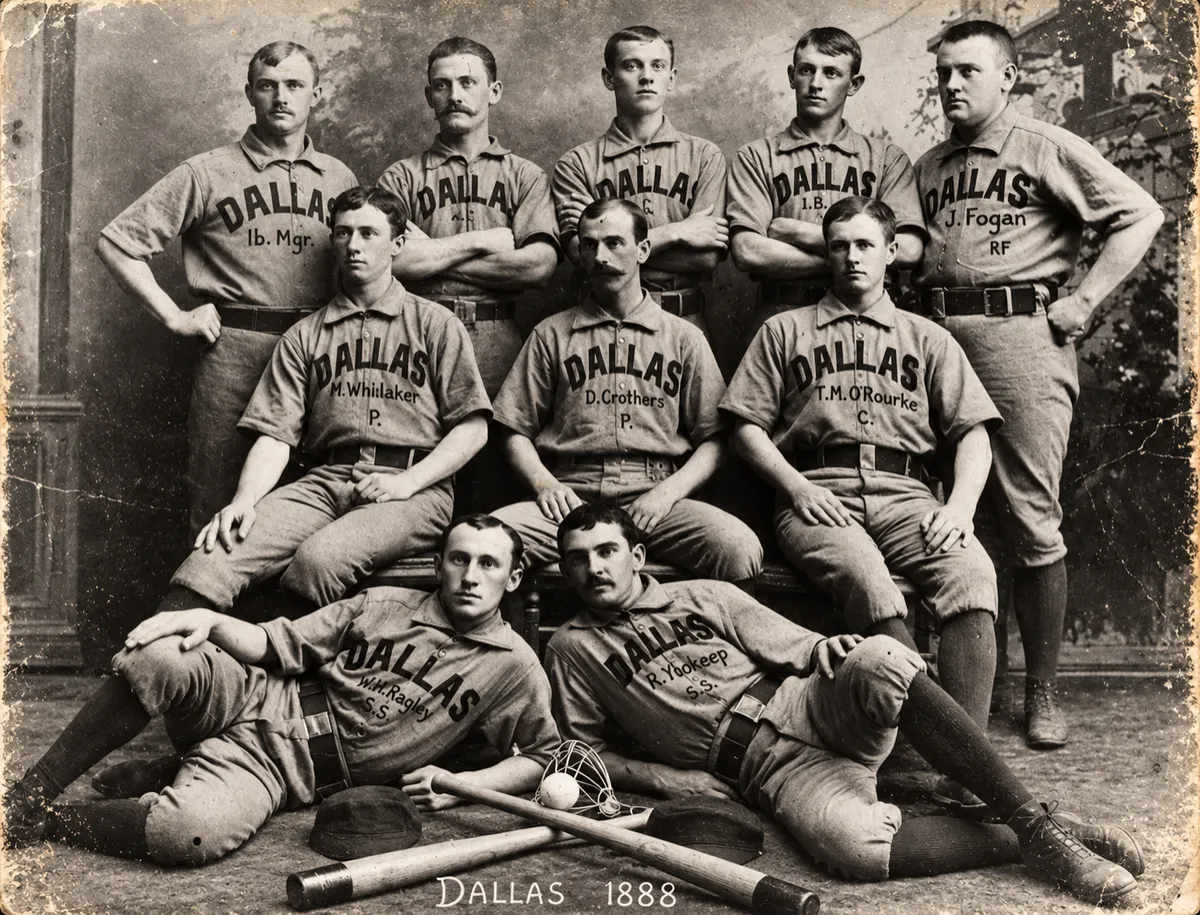
In 1888, the Hams became the first champions of the newly organized Texas League.
They accomplished it during one of the most chaotic seasons imaginable.
Teams disappeared. Players went unpaid. Railroad problems disrupted schedules. Club owners argued over league decisions. Even the umpires sometimes became part of the story.
Through it all, Dallas kept winning.
And when the dust finally settled, the Hams had claimed not one, but two league titles in a single season.
It was an extraordinary beginning for professional base ball in the Lone Star State.
THE ARCHIVE RECORD
Club: Dallas Hams
Location: Dallas, Texas
League: Texas League / Texas-Southern League
Years Under the Hams Name: 1888, 1890, 1892
Championships: 1888 Texas League and Texas-Southern League
Home Grounds: Oak Cliff Park (1888)
1888 Record: 35–18 in the original Texas League; 21–8 in the Texas-Southern League
Notable Players: James "Tub" Welsh, Charlie Levis, Doug Crothers, Joe Fogarty
Club President: Leon Vendig
A NEW LEAGUE IN THE LONE STAR STATE
In December 1887, representatives from several Texas cities gathered to organize a new professional baseball league.
Dallas, Fort Worth, Houston, Galveston, Austin and San Antonio were eager to establish clubs.
The Texas League was born.
Dallas businessman Leon Vendig helped organize the city's new franchise through the Dallas Athletic and Amusement Association.
His ambitions extended beyond simply putting nine players on a field.
Vendig wanted a first-class baseball organization, one that would attract respectable crowds and establish professional baseball as an important part of Dallas entertainment.
The club recruited experienced players from outside Texas, including men with Major League experience.
Even the powerful St. Louis Browns, champions of the American Association in 1887, helped generate excitement by promising players to the Dallas organization.
Exhibition games against Cincinnati brought large crowds before the regular season began.
Dallas was ready for professional base ball.
And the Hams were ready to give the city something worth cheering about.
BASE BALL ACROSS THE TRINITY
The Hams played their home games at Oak Cliff Park, located across the Trinity River from downtown Dallas.
The suburban location presented a challenge.
Fans needed a convenient way to reach the ballpark.
Fortunately, developer J. T. Marsalis operated the Oak Cliff Railroad, which provided special transportation to games for just five cents.
Admission to the ballpark cost another 25 cents.
The grounds were designed to provide an attractive setting for spectators, with a grandstand and accommodations intended to appeal to a broad audience.
Wednesdays were designated Ladies' Day, allowing women to attend without paying admission.
Management promoted a respectable atmosphere and discouraged profanity and disorderly behavior.
The team even received favorable newspaper publicity suggesting its players avoided strong drink.
But nineteenth-century baseball was rarely as orderly as its promoters hoped.
Gambling remained common.
Fans argued over calls.
And the Hams' growing rivalry with the Fort Worth Panthers could produce some particularly enthusiastic crowds.
More than 3,000 spectators attended opening-day ceremonies, with hundreds more standing around the outfield.
Professional baseball had found an audience in Dallas.
CHAMPIONS OF A LEAGUE FALLING APART
On the field, the Hams quickly established themselves as the team to beat.
Off the field, the Texas League was struggling to survive.
The problems began almost immediately.
Travel expenses were high. Railroad schedules were unreliable. Rain disrupted games, and several clubs struggled to attract enough spectators to cover expenses.
By June, the situation had become desperate.
San Antonio withdrew.
Fort Worth folded.
Houston experienced financial difficulties.
Austin struggled to pay its players.
One by one, the teams began disappearing.
Dallas, however, remained competitive and financially stronger than most of its rivals.
When the original Texas League season came to an early end, the Hams stood atop the standings with a 35–18 record.
They were champions.
But their season wasn't finished.
Officials attempted to rescue professional baseball in the region by combining surviving Texas clubs with teams from the troubled Southern League.
The result was the Texas-Southern League.
Dallas entered the reorganized circuit and continued winning.
The Hams posted a 21–8 record, including six victories in eight meetings with their strongest rival, the New Orleans Pelicans.
On September 3, 1888, the remaining clubs agreed to end the season.
Dallas once again stood on top.
Two championships.
Two leagues.
One remarkable season.
THE CHARACTERS BEHIND THE HAMS
The Dallas Hams featured an assortment of colorful personalities, many of whom had already experienced professional baseball elsewhere.
Perhaps the most popular was catcher James "Tub" Welsh.
Welsh earned his nickname from his substantial build and became a favorite among Dallas spectators.
He was also known for constantly chewing gum.
Behind the plate, Welsh helped anchor the club during its championship season before being sold to Buffalo.
He later returned to Dallas and eventually reached the Major Leagues.
Manager Charlie Levis was another experienced baseball man.
A former Major League player, Levis brought leadership and professional experience to the young organization.
The roster also included outfielder Joe Fogarty, who had previously played for St. Louis, and Doug Crothers, a pitcher who would later assume managerial responsibilities.
Not all of the club's history was admirable. Crothers had been involved in a racist confrontation while playing for Syracuse in 1887, when he objected to sharing a team with a Black pitcher. The incident was not reported in Dallas accounts of his 1888 season.
Of the 19 players who appeared for substantial portions of the Hams' championship campaign, eight had played or would eventually play in the Major Leagues.
None became household names.
But together, they formed the most successful team in the first season of the Texas League.
WHEN BASE BALL WAS ANYTHING BUT ORDINARY
If the championship season sounds unusual, some of the individual incidents were even stranger.
At one point, a visiting team failed to appear for a scheduled game.
It wasn't an isolated occurrence.
According to historical accounts, opponents failed to show up for games against Dallas on three separate occasions.
Railroad breakdowns sometimes delayed clubs for days.
During one June game, the Hams actually stopped play in the third inning so club president Leon Vendig could present Austin manager John McCloskey with a gold-headed ebony cane.
The gift recognized McCloskey's decision to honor an existing schedule despite objections from league officials.
In another bizarre incident, an Oak Cliff Railroad train overturned while transporting spectators to a game.
Several passengers were injured, along with Dallas manager Charlie Levis.
And in Fort Worth, an umpire preparing to officiate a game reportedly signed a contract with the Panthers and played right field instead.
Such was professional baseball in Texas in 1888.
The rules of the game were established.
The business of keeping a league alive was another matter entirely.
WHAT HAPPENED TO THE DALLAS HAMS?
The championship season of 1888 did not bring immediate stability to professional baseball in Dallas.
The city returned to the Texas League in 1889, but the club was known as the Dallas Tigers.
The league again experienced financial trouble and failed to complete its season.
Dallas revived the Hams name in 1890, but that campaign also ended prematurely when the league collapsed in June.
After sitting out the 1891 season, Dallas fielded another team called the Hams in 1892.
That season marked the final documented appearance of the name in the city's professional baseball records.
The city went without a Texas League entry in 1893 and 1894.
By 1895, Dallas baseball had entered another chapter under the Steers name.
Over the following decades, Dallas clubs would compete under names including the Giants, Marines, Submarines, Rebels and Eagles.
The original Hams gradually disappeared from popular memory.
But their achievement remained.
They had won the Texas League's first championship.
They had survived the collapse of their original circuit and captured another title in the same year.
And they helped establish a professional baseball tradition that would continue in North Texas for generations.
Today, the Dallas Hams are rarely mentioned alongside the more familiar names in Texas baseball history.
Their uniforms are obscure.
Their players have largely faded from memory.
Even the origins of their unusual nickname remain uncertain.
But in 1888, when professional baseball in Texas was struggling simply to survive, the Dallas Hams were champions.
Before the Rangers.
Before the Eagles.
Before the Steers.
There were the Hams.
And they belong in the Archive.
EXPLORE OUR DALLAS HAMS COLLECTION
GHOST LEAGUE ARCHIVE
Forgotten Teams. Unforgettable Legacy.
HISTORICAL NOTE:
Ghost League Supply Co. researches each Archive entry using available historical records and sources. Because many early teams were poorly documented, dates, records, names and other details may vary between sources.
Some images and artwork appearing in the League Archive are AI-assisted historical interpretations created for illustrative purposes and should not be considered authentic photographs, official team artwork or exact historical reconstructions.