Zanesville Flood Sufferers: The Ballclub That Refused to Wash Away
Ghost League Archive: FILE 0007
ZANESVILLE FLOOD SUFFERERS
Zanesville, Ohio • Interstate League • Class B • 1913

WHEN THE RIVER TOOK THE BALLPARK
Some baseball teams disappear because of poor attendance. Others fold when the money runs out.
The Zanesville Flood Sufferers had a different problem.
Their ballpark was destroyed before the season could even get underway.
In the spring of 1913, devastating floods swept across Ohio, leaving communities underwater, businesses ruined, and families struggling to recover.
Zanesville, a manufacturing city at the meeting of the Muskingum and Licking rivers, was among the communities hit by the disaster.
The city's professional baseball club faced an uncertain future.
Its home grounds were gone.
The surrounding community was struggling to recover.
And a new baseball season was rapidly approaching.
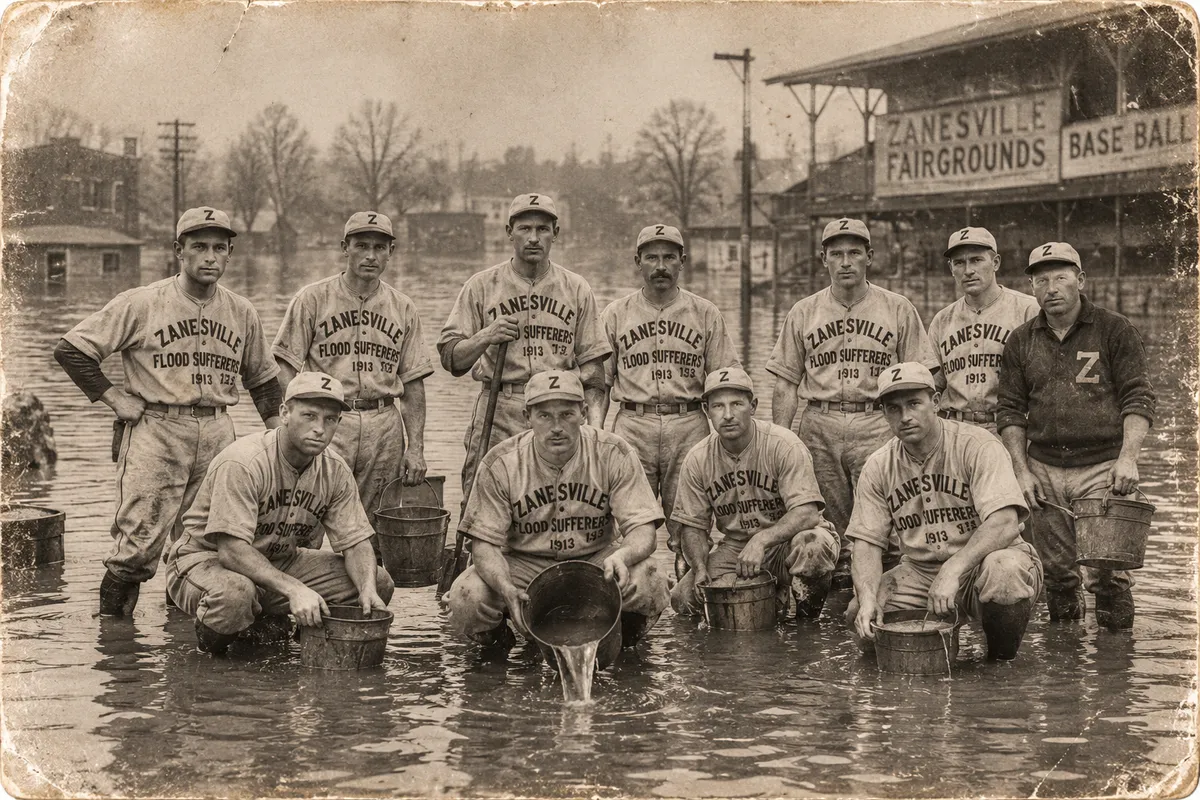
But instead of immediately surrendering its place in the league, Zanesville found another place to play.
The fairgrounds.
And with a nickname that reflected the disaster surrounding them, the Zanesville Flood Sufferers took the field.
Their story would last only a few months.
But it remains one of the most unusual chapters in minor league baseball history.
THE ARCHIVE RECORD
Club: Zanesville Flood Sufferers
Location: Zanesville, Ohio
League: Interstate League
Classification: Class B
Season: 1913
Previous Club Name: Zanesville Potters
Manager: Marty Hogan
Record: 27 wins, 46 losses
Winning Percentage: .370
League Finish: Eighth place
Home Grounds: Fairgrounds following flood damage
Final Season Date: July 13, 1913
A BASEBALL TOWN BEFORE THE FLOOD
Zanesville's baseball history began long before the Flood Sufferers appeared.
In the late nineteenth century, the city supported professional clubs with names that reflected both local industry and the colorful imagination of early baseball promoters.
There were the Kickapoos.
The Clay Diggers.
The Moguls.
The Infants.
And eventually, the Potters.
The Potters represented Zanesville in the Central League from 1910 through 1912, competing against clubs from other industrial communities across the Midwest.
Baseball was part of the city's sporting identity.
It provided entertainment for factory workers, merchants, families, and fans who followed their local nine through the summer months.
For 1913, Zanesville joined the newly organized Interstate League.
The eight-team circuit brought together clubs from Ohio, Pennsylvania, and West Virginia.
Among the opponents were the Akron Giants, Canton Senators, Columbus Cubs, Erie Sailors, Steubenville Stubs, Wheeling Stogies, and Youngstown Steelmen.
It promised another season of professional baseball.
Then came the flood.
THE GREAT FLOOD OF 1913
In late March 1913, an extraordinary weather system brought days of heavy rainfall across the Ohio Valley and much of the Midwest.
Rivers rose beyond their banks.
Railroad lines were washed out.
Bridges were damaged or destroyed.
Homes, factories, and businesses disappeared beneath the floodwaters.
Zanesville's location at the confluence of two rivers made it particularly vulnerable.
The disaster followed another blow to the community: a destructive tornado had struck the area in 1912.
Now the city faced widespread flooding.
The damage extended to its baseball facilities.
According to contemporary reporting inSporting Life, the Zanesville ballpark had been completely destroyed.
For a minor league organization already operating on a limited budget, losing its home grounds was a potentially fatal setback.
Baseball clubs of the era depended heavily on ticket sales.
Without a ballpark, there were no paying spectators.
Without spectators, there was little money to cover player salaries, equipment, and travel expenses.
The Flood Sufferers faced a problem far larger than their next opponent.
They needed somewhere to play.
FROM THE BALLPARK TO THE FAIRGROUNDS
The club's response was straightforward.
If the original ballpark was gone, they would find another field.
In April 1913,Sporting Lifereported that Zanesville intended to remain in the Interstate League despite the devastating flood.
The publication explained that the team's ballpark had been destroyed and that games would instead be played at the fairgrounds.
It was a remarkable decision.
The city was still recovering, yet its baseball club intended to honor its place in the league.
There would be no familiar home diamond.
No return to the old grandstand.
Instead, the team would attempt to continue its season at an alternative location.
The exact arrangements and conditions of the temporary grounds are not fully documented in surviving records.
But the determination to continue was unmistakable.
The team that had lost its ballpark was still planning to play baseball.
And the nickname Flood Sufferers would forever connect the club to the events of that spring.
THE MAN IN CHARGE: MARTY HOGAN
Managing the Flood Sufferers was Marty Hogan, a longtime baseball figure with experience in both the Major and Minor Leagues.
Hogan had played professional baseball during the nineteenth century, including time in the National League.
By 1913, his playing days were behind him, but he remained involved in the sport as a manager.
Leading the Flood Sufferers was hardly an enviable assignment.
The team faced the ordinary difficulties of minor league baseball, including travel, expenses, and competition from stronger clubs.
But it also carried the additional burden of representing a city recovering from a natural disaster.
Hogan's club struggled to keep pace with the rest of the league.
The Erie Sailors emerged as the circuit's dominant team.
Akron and Youngstown also enjoyed winning seasons.
Zanesville, meanwhile, fell toward the bottom of the standings.
The Flood Sufferers finished with 27 victories and 46 defeats.
Their .370 winning percentage placed them eighth in the league.
But the standings tell only part of the story.
The team had entered a season in which its original home grounds no longer existed.
Simply taking the field was an accomplishment.
A FUTURE WORLD SERIES PITCHER
Among the players who appeared for Zanesville in 1913 was a young pitcher named Samuel Pond Jones.
Baseball fans would later know him as Sad Sam Jones.
Jones was still developing his professional career when he pitched for the Flood Sufferers.
Available minor league records credit him with a 2–7 record and a 3.24 earned run average in 13 appearances for Zanesville.
His career would take him far beyond the fairgrounds of eastern Ohio.
Jones eventually reached the Major Leagues, where he pitched for several clubs, including the Cleveland Indians, Boston Red Sox, New York Yankees, St. Louis Browns, Washington Senators, and Chicago White Sox.
He became a member of the Boston team that won the 1918 World Series and later pitched a no-hitter for the Yankees in 1923.
It is a remarkable connection.
A pitcher who would eventually become a World Series champion and throw a Major League no-hitter once wore the uniform of the Zanesville Flood Sufferers.
For a team remembered primarily for disaster and defeat, Jones provides a link to some of baseball's most celebrated history.
WHEN THE SEASON FINALLY ENDED
The Flood Sufferers managed to survive the spring.
They could not survive the entire summer.
By July, the Interstate League was in serious financial trouble.
The floods had affected multiple communities within the circuit.
Travel expenses and unstable attendance created additional difficulties.
The emergence of the Federal League also placed pressure on existing minor league organizations by competing for players.
On July 13, 1913, the Zanesville Flood Sufferers disbanded.
Their final record stood at 27–46.
Just eight days later, on July 21, the entire Interstate League ceased operations.
The Flood Sufferers had lasted nearly as long as the league itself.
Their brief existence had begun in the aftermath of one disaster and ended amid another kind of collapse.
The flood destroyed their ballpark.
Financial instability helped bring an end to their season.
And professional baseball in Zanesville entered another period of uncertainty.
WHAT HAPPENED TO THE FLOOD SUFFERERS?
The Flood Sufferers name never returned to professional baseball.
After the 1913 season, Zanesville went nearly two decades without another established minor league franchise.
Professional baseball returned in 1933 with the Zanesville Greys of the Middle Atlantic League.
Later clubs included the Zanesville Cubs and Zanesville Dodgers.
The city's baseball tradition continued, but the Flood Sufferers became a footnote in the historical record.
There were no championship banners.
No long-running dynasty.
No legendary ballpark that survived for generations.
Just a team that played one shortened season under circumstances few baseball clubs have ever faced.
And perhaps that is what makes their story worth remembering.
The Zanesville Flood Sufferers were not named for a sponsor, a local industry, or a fearsome animal.
They were named for a disaster that had changed their community.
They represented a city attempting to recover.
They played after losing their home grounds.
And for a few months in 1913, they carried on.
Some teams are remembered for what they won.
Others deserve to be remembered for what they endured.
The Zanesville Flood Sufferers belong in the Archive.
EXPLORE OUR ZANESVILLE FLOOD SUFFERERS COLLECTION
GHOST LEAGUE ARCHIVE
Forgotten Teams. Unforgettable Legacy.
HISTORICAL NOTE:
Ghost League Supply Co. researches each Archive entry using available historical records and sources. Because many early teams were poorly documented, dates, records, names and other details may vary between sources.
Some images and artwork appearing in the League Archive are AI-assisted historical interpretations created for illustrative purposes and should not be considered authentic photographs, official team artwork or exact historical reconstructions.