Douglas Demons: The Copper Town Team That Helped Create the Original Cactus League
Ghost League Archive: FILE 0008
DOUGLAS DEMONS
Douglas, Arizona Territory | Independent Baseball | 1909–1910

Before the Cactus League Was the Cactus League
Long before Arizona became the spring-training home of Major League Baseball, there was another Cactus League.
It had no multimillion-dollar stadiums.
No television contracts.
And no major-league organizations sending their players south for the spring.
Instead, it had copper mines, dusty ballfields, railroad excursions, fiercely loyal fans, and professional ballplayers willing to travel into the Arizona Territory for a chance to earn a living.
And among its most formidable clubs was a baseball team from Douglas, Arizona.
The Douglas Demons.
Their story unfolded before Arizona achieved statehood, when copper was king and baseball was becoming one of the most important forms of entertainment in the growing communities along the Mexican border.
The Demons were more than a group of local workers playing weekend baseball.
They recruited professional talent, competed against some of the Southwest's strongest independent clubs, and helped establish an ambitious baseball circuit that anticipated Arizona's later prominence in the game.
Their roster even included the younger brother of one of baseball's greatest pitchers.
But the original Cactus League was also a world of shifting rosters, questionable contracts, rowdy spectators, and financial problems.
And the Douglas Demons experienced nearly all of it.
THE ARCHIVE RECORD
Club: Douglas Demons, also called O'Donovan's Demons
Location: Douglas, Arizona Territory
League: Informal Cactus League (1909); Independent Cactus League (1910)
Primary Era: 1909–1910
Club Type: Independent / Semi-Professional
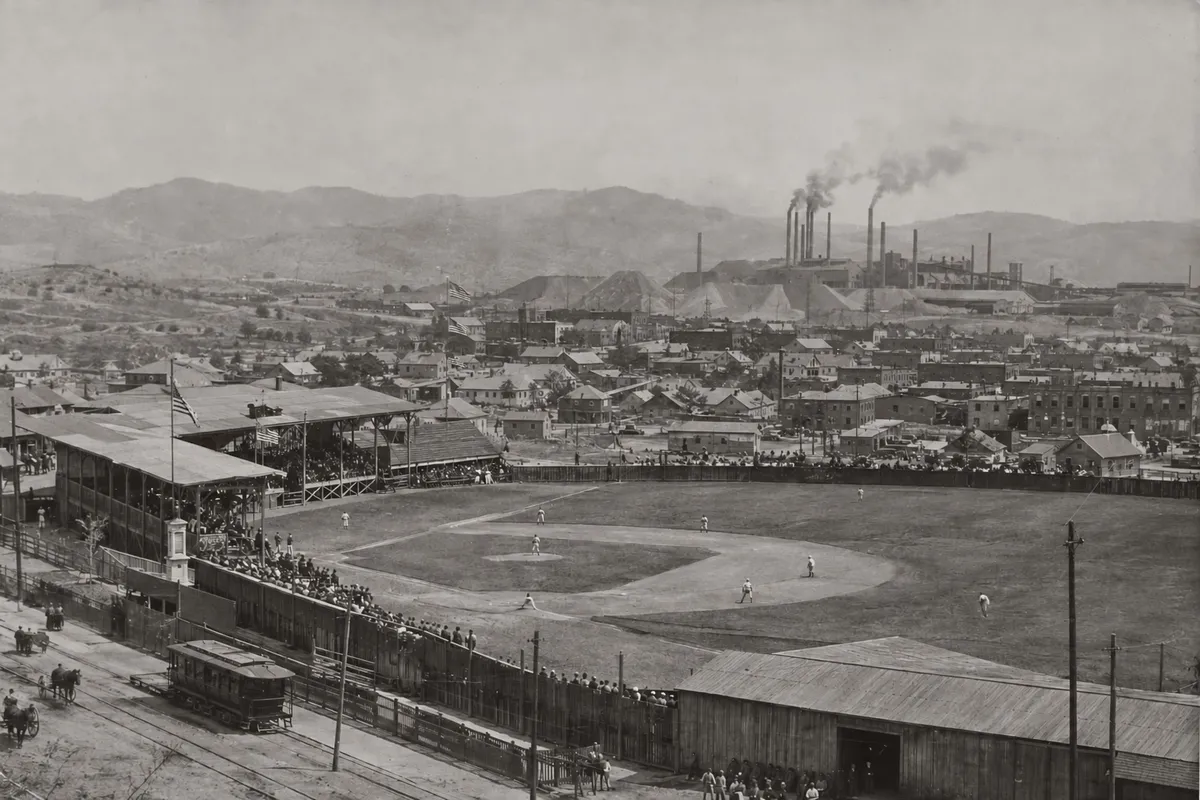
Home Grounds: Sportsman's Park
1909 Record: 34 wins, 20 losses
1909 Achievement: Recognized as informal Cactus League champions
1910 Result: Contended for the pennant; Cananea ultimately won
Notable Manager: Daniel A. O'Donovan
Notable Players: Henry Mathewson, Eli Cates, Harry Kane
Principal Rivals: Bisbee, Cananea, El Paso
*The early Cactus League operated with irregular schedules and changing membership. Its records should not be interpreted as equivalent to those of a modern organized professional league.
A Copper Town on the Rise
At the beginning of the twentieth century, Douglas was one of Arizona Territory's rapidly growing communities.
Its growth was driven by copper.
Located near the Mexican border, Douglas developed into an important center for smelting and processing copper ore from mines throughout southeastern Arizona.
Industrial facilities, railroad connections, and new businesses attracted workers and families.
In 1901, Douglas had approximately 500 residents.
By 1910, its population had grown to more than 6,000.
It was a remarkable transformation in less than a decade.
As the community expanded, so did its appetite for recreation.
Baseball provided something that a mining and smelting town could rally around.
Workers who spent their weekdays around furnaces, machinery, and railroad yards could spend their weekends cheering for the local nine.
And there was no shortage of nearby rivals.
Bisbee had its own baseball club.
So did Cananea, across the border in Mexico.
El Paso fielded strong teams, and other Arizona communities, including Clifton and Morenci, participated in the growing baseball culture of the Southwest.
The distances were considerable.
The rivalries were not.
For Douglas, beating another copper town on the baseball diamond became a source of community pride.
Building a Ballpark for a Growing City
By 1907, Douglas had moved beyond the most primitive arrangements for local baseball.
That year, Sportsman's Park was constructed with a grandstand and box seating.
The park stood at the eastern end of the Douglas street railway.
Its location was no coincidence.
The Douglas Street Railway Company funded the ballpark, connecting it to the community's transportation and industrial infrastructure.
Approximately four miles of track linked the park with the city's smelter.
The same system that helped move people around the growing copper town also helped bring spectators to baseball games.
The railway's manager, Daniel A. O'Donovan, became an important figure in the club's development.
He managed both the railway and the baseball team.
The club became affectionately known as O'Donovan's Demons.
It was an appropriate nickname for a team competing in the rough-and-tumble baseball environment of the Arizona borderlands.
By the opening of the 1910 season, Sportsman's Park had been renovated to accommodate the growing interest in the game.
Douglas was preparing to compete at a higher level.
The Demons Become Champions
The 1909 season helped establish Douglas as one of the Southwest's strongest baseball towns.
At the time, the Cactus League was an informal collection of teams from Douglas, Bisbee, Cananea, and El Paso, with other clubs appearing on schedules when arrangements could be made.
There was no perfectly balanced season.
Managers challenged other teams, negotiated games, and arranged return visits.
Some opponents appeared repeatedly.
Others might visit only once.
Douglas played Cananea 21 times in 1909, while meeting several smaller clubs only once apiece.
Despite the irregular schedule, Douglas emerged with a 34–20 record.
The club was recognized as the informal Cactus League champion.
But the most memorable confirmation of its standing came in November.
At El Paso's annual baseball tournament, Douglas faced a team from Socorro featuring an extraordinary pitcher.
Rube Waddell.
The eccentric future Hall of Famer was already one of baseball's most recognizable personalities, famous for his tremendous talent and unpredictable behavior.
In front of approximately 3,500 spectators, Douglas defeated Socorro.
For a territorial baseball club, beating a team featuring one of the game's legendary pitchers was a remarkable accomplishment.
Douglas had proven it could compete with serious talent.
The following year, the competition would become even more ambitious.
The Original Cactus League
In 1910, the mining towns of the Southwest attempted something that had been discussed for years.
They wanted a more formally organized baseball league.
Representatives from Douglas, El Paso, and Cananea had approached the National Association of Professional Baseball Leagues about creating an affiliated circuit.
The proposal initially gained approval at the Class D level.
But the arrangement quickly encountered resistance.
Cananea, backed by the wealthy Cananea Consolidated Copper Company, had little interest in accepting restrictions on player salaries.
Its club also employed players whose contract histories made them unacceptable to organized baseball.
Joining the National Association would have required significant changes.
Other clubs eventually sided with Cananea.
The result was a league that remained independent.
It operated outside the established professional baseball system.
This made the original Cactus League a particularly unusual competition.
Teams could recruit experienced professional players.
Players could move between clubs.
Some were attracted by offers of employment with local industrial companies.
Others simply followed the money.
The quality of baseball improved dramatically, but the league lacked many of the controls that helped established professional circuits maintain stability.
It was an exciting arrangement.
It was also a dangerous financial gamble.
A Mathewson Comes to Douglas
Among the players recruited by Douglas for the 1910 season was a familiar baseball name.
Henry Mathewson.
He was the younger brother of Christy Mathewson, the celebrated New York Giants pitcher who would eventually enter the Baseball Hall of Fame.
Henry had also appeared with the Giants.
His major-league career was brief, but his experience gave the Douglas roster an intriguing connection to the highest level of professional baseball.
In Douglas, Henry Mathewson pitched occasionally but spent most of the season playing the outfield.
He was not the only former major leaguer on the club.
Pitcher Eli Cates had appeared in 19 games for the Washington Nationals in 1908.
Cates had posted a 2.55 earned run average during that major-league season.
Other members of the Douglas roster brought experience from the Texas League and Pacific Coast League.
The team was hardly a casual gathering of local amateurs.
In the 1910 census, ten members of the Douglas club identified themselves as professional baseball players.
This was a level of talent that would have been difficult to imagine in the region just a few years earlier.
The Demons were playing serious baseball.
And the town was ready to support them.
Baseball, Special Trains, and Territorial Rivalries
The official opening weekend of the 1910 Cactus League began April 30.
Douglas traveled to Bisbee.
The region treated the occasion as more than another sporting event.
Special trains carried spectators between towns, with discounted fares encouraging fans to follow their clubs on the road.
Opening festivities included parades, marching bands, and ceremonial first pitches.
Baseball had become a public celebration.
Douglas and Bisbee sold close to 2,000 tickets during the opening weekend.
For relatively small territorial communities, that was significant support.
Fans were willing to spend money and travel considerable distances to see their teams compete.
And they expected their players to win.
The competition between mining towns could be intense.
Clubs recruited new talent throughout the season.
Managers tried to strengthen weak positions.
Professional scouts began taking an interest in the players appearing on Southwestern diamonds.
The original Cactus League had created a baseball environment that was much closer to professional competition than the ordinary town-ball games of an earlier generation.
But enthusiasm could also create problems.
When the Grandstand Burned
On May 23, 1910, disaster struck Sportsman's Park.
A fire destroyed the grandstand at Douglas.
The damage created an immediate financial problem for the club.
Games could continue, but the park was no longer properly enclosed.
Some spectators discovered they could enter through the opening left by the fire without purchasing tickets.
For a team dependent on gate receipts, that was a serious problem.
The grandstand required repairs.
Meanwhile, the club still had to pay players, maintain its grounds, and cover the expenses of competing across a geographically scattered league.
It was a reminder of how vulnerable early independent baseball organizations could be.
A modern professional franchise might absorb a stadium repair as a business expense.
A territorial club operating on limited receipts could find itself in serious trouble.
And the grandstand fire was only one of the challenges facing the league.
A Fourth of July to Remember
Despite the challenges, Douglas remained one of the league's strongest clubs.
On July 4, 1910, the Demons traveled to Bisbee for an Independence Day celebration that combined baseball with the festivities of a mining town.
The streets were decorated with patriotic bunting.
There were speeches, marching bands, athletic contests, and mining competitions.
And the day's main sporting attraction was a doubleheader between the rival baseball clubs.
Douglas won both games.
The holiday sweep was more than another pair of victories.
It demonstrated how important baseball had become to the communities of southeastern Arizona.
For fans, the Demons represented their town against its neighbors.
For the players, the games offered an opportunity to compete in front of enthusiastic crowds.
And for the league, celebrations like this represented the promise of a profitable future.
Unfortunately, that promise would prove difficult to fulfill.
When Winning Wasn't Enough
The original Cactus League offered players opportunities they might not find in organized baseball.
But the freedom came at a price.
Without the usual reserve-clause protections, teams struggled to keep their rosters intact.
Players could leave for better opportunities.
Others arrived after being released by professional clubs elsewhere.
Some moved between competing Cactus League teams.
In 1910, fewer than half of the players appearing on the league's opening-day rosters remained with their original teams throughout the season.
Douglas was among the more stable clubs.
Seven of its opening-day players stayed through the campaign.
But stability did not guarantee financial success.
The league also struggled with umpiring disputes, uneven scheduling, and the costs of recruiting professional talent.
Some clubs simply ran out of money.
Clifton and Morenci withdrew in September.
Bisbee followed later that month.
Douglas, meanwhile, remained a serious championship contender.
The Demons led the standings at several points during the season, including late August.
But the final weeks brought further instability.
As clubs withdrew, the remaining teams struggled to settle the championship.
Cananea finished with a 30 - 23 record and was declared the 1910 pennant winner.
Its claim was subsequently confirmed after a protest from El Paso.
Douglas had challenged for another title, but the championship belonged to Cananea.
The Demons' financial situation was no better than that of their competitors.
Douglas ended the campaign more than $2,000 in debt.
For a baseball club in 1910, that was a considerable burden.
The original Cactus League had demonstrated that the Southwest could support high-quality baseball.
It had also demonstrated how difficult it was to make that baseball financially sustainable.
What Happened to the Demons?
The ambitious independent Cactus League experiment did not survive beyond 1910 in the form its organizers had envisioned.
As the circuit collapsed, local baseball gradually returned to a more modest structure.
Town teams continued to play.
Industrial clubs remained important.
But the expensive recruitment of large numbers of experienced professionals became harder to justify.
Douglas did not disappear from baseball history.
In 1915, the city joined the newly organized Rio Grande Association, a Class D professional league and Arizona's first affiliated minor-league circuit.
Douglas opened its season May 4, losing 9 - 6 at Albuquerque.
The club entered the league without an established nickname, while a local newspaper contest was underway to select one.
Unfortunately, the experiment was short-lived.
On May 25, the league eliminated the Douglas and Las Cruces franchises because of financial difficulties and insufficient support.
The remaining four clubs continued playing until early July, when the entire league folded.
Later decades brought additional professional baseball to the Douglas area, including clubs associated with nearby Bisbee and the Arizona–Texas and Arizona–Border leagues.
The names changed.
The leagues changed.
But Douglas's connection to baseball endured.
The Demons became part of a much larger story: the development of baseball in the American Southwest before the modern spring-training era.
A Cactus League Before Spring Training
Today, the Cactus League is associated with warm March afternoons, major-league uniforms, and spring-training ballparks across metropolitan Phoenix.
The original Cactus League was something entirely different.
It belonged to mining towns, railroad excursions, and industrial employers.
Its players included local favorites, professional veterans, and men who had left organized baseball for better opportunities.
Its fans traveled between isolated communities to support their teams.
And its clubs operated in a region that was still developing its identity.
Douglas was one of the places where that identity took shape.
The Demons helped demonstrate that serious baseball could thrive in the Arizona Territory.
Their story included an informal championship, a victory over a team featuring Rube Waddell, a former New York Giant, a burned grandstand, a memorable Fourth of July sweep, and the collapse of an ambitious independent league.
They never became a lasting professional franchise.
Their championship did not make them nationally famous.
But for a few extraordinary seasons, the Douglas Demons represented one of the strongest baseball communities in the Southwest.
Before the Cactus League belonged to spring training, it belonged to towns like Douglas.
And before Arizona became a destination for Major League Baseball, the Demons were already helping build its baseball history.
Some teams are remembered for the championships they won.
Others deserve to be remembered for the game they helped establish.
The Douglas Demons belong in the Archive.
EXPLORE OUR DOUGLAS DEMONS COLLECTION
GHOST LEAGUE ARCHIVE
Forgotten Teams. Unforgettable Legacy.
HISTORICAL NOTE:
Ghost League Supply Co. researches each Archive entry using available historical records and sources. Because many early teams were poorly documented, dates, records, names and other details may vary between sources.
Some images and artwork appearing in the League Archive are AI-assisted historical interpretations created for illustrative purposes and should not be considered authentic photographs, official team artwork or exact historical reconstructions.