Brooklyn Excelsiors: The Forgotten Club That Helped Change Baseball Forever
Ghost League Archive: FILE 0009
BROOKLYN EXCELSIORS
Brooklyn, New York | Amateur Base Ball | 1854–1870

Before Baseball Had a Major League
Before the Brooklyn Dodgers.
Before the National League.
Before professional baseball clubs traveled across America chasing pennants and paying players to win games, there was a group of young men in Brooklyn who helped change the game forever.
They were the Brooklyn Excelsiors.
Founded in 1854, the Excelsior Base Ball Club belonged to a remarkable generation of teams that transformed baseball from a neighborhood pastime into an organized national sport.
They played on fields that barely resembled modern ballparks.
They competed without gloves.
They wore uniforms that would look unusual to today's fans.
And they played at a time when baseball was still deciding what kind of game it wanted to become.
But the Excelsiors were no ordinary amateur club.
They introduced new approaches to pitching, helped popularize an early version of the modern baseball cap, and undertook one of the first extended baseball tours in American history.
Their greatest star became one of the game's earliest national celebrities.
His name was Jim Creighton.
And his extraordinary talent would help change baseball forever.
The Excelsiors never became a Major League franchise.
Their name eventually disappeared from the sporting landscape.
But their influence can still be found in nearly every baseball game played today.
THE ARCHIVE RECORD
Club: Excelsior Base Ball Club of Brooklyn
Location: South Brooklyn, New York
Founded: December 8, 1854
Principal Era: 1854–1870
Association: National Association of Base Ball Players
Club Type: Amateur baseball club, with evidence of early compensated players
Early Grounds: Carroll Park area, later South Brooklyn grounds near Court Street
Notable Players: Jim Creighton, Joe Leggett, Asa Brainard, Candy Cummings
Historic Achievement: Pioneering extended baseball tour, 1860
Principal Rivals: Brooklyn Atlantics, Eckford of Brooklyn, New York Knickerbockers
Historical Significance: Early pitching innovation, baseball touring, and uniform development
*The Excelsiors played before modern professional leagues and standardized statistical recordkeeping. Surviving match records do not provide a complete modern-style season history.
When Brooklyn Was Baseball's Capital
In the middle of the nineteenth century, Brooklyn was becoming one of the most important baseball communities in America.
The growing city was home to numerous organized clubs.
Some represented neighborhoods.
Others developed around social circles, occupations, or groups of young men who shared an enthusiasm for the increasingly popular game of base ball.
The Brooklyn Atlantics became one of the era's most celebrated clubs.
The Eckfords of Greenpoint developed a powerful reputation.
And in South Brooklyn, the Excelsiors emerged as another formidable organization.
The club was established in December 1854, when organized baseball was still in its infancy.
There were no professional minor leagues.
No national championship series comparable to the modern World Series.
And no Major League Baseball organization overseeing the sport.
Instead, clubs arranged matches directly with one another.
They challenged neighboring teams, negotiated playing dates, and built reputations through victories reported in local newspapers.
Baseball was still closely tied to social clubs and community identity.
But the competition was becoming increasingly serious.
By 1857, the National Association of Base Ball Players had formed, bringing together clubs that sought greater consistency in the rules and organization of the game.
Brooklyn was heavily represented.
The Excelsiors belonged to this rapidly changing baseball world.
And within a few years, they would become one of its most influential teams.
A Different Kind of Ballgame
To understand the Excelsiors, it helps to understand how different baseball was in the 1850s.
The pitcher did not stand on a raised mound.
There was no strike zone enforced in quite the modern fashion.
Pitchers delivered the ball underhand, and the rules originally emphasized giving batters an opportunity to strike it.
The game was designed around balls being put into play.
Fielders generally played barehanded.
A ball caught on its first bounce could still retire a batter under the prevailing rules.
Matches could produce scores that seem astonishing today.
Twenty, thirty, or even more runs by a team were hardly unheard of.
The sport was still developing its balance between pitching, hitting, and fielding.
That balance would begin to change dramatically when a young pitcher joined the Excelsiors.
But before he arrived, the club was already building a distinctive identity.
The Birth of a Baseball Look
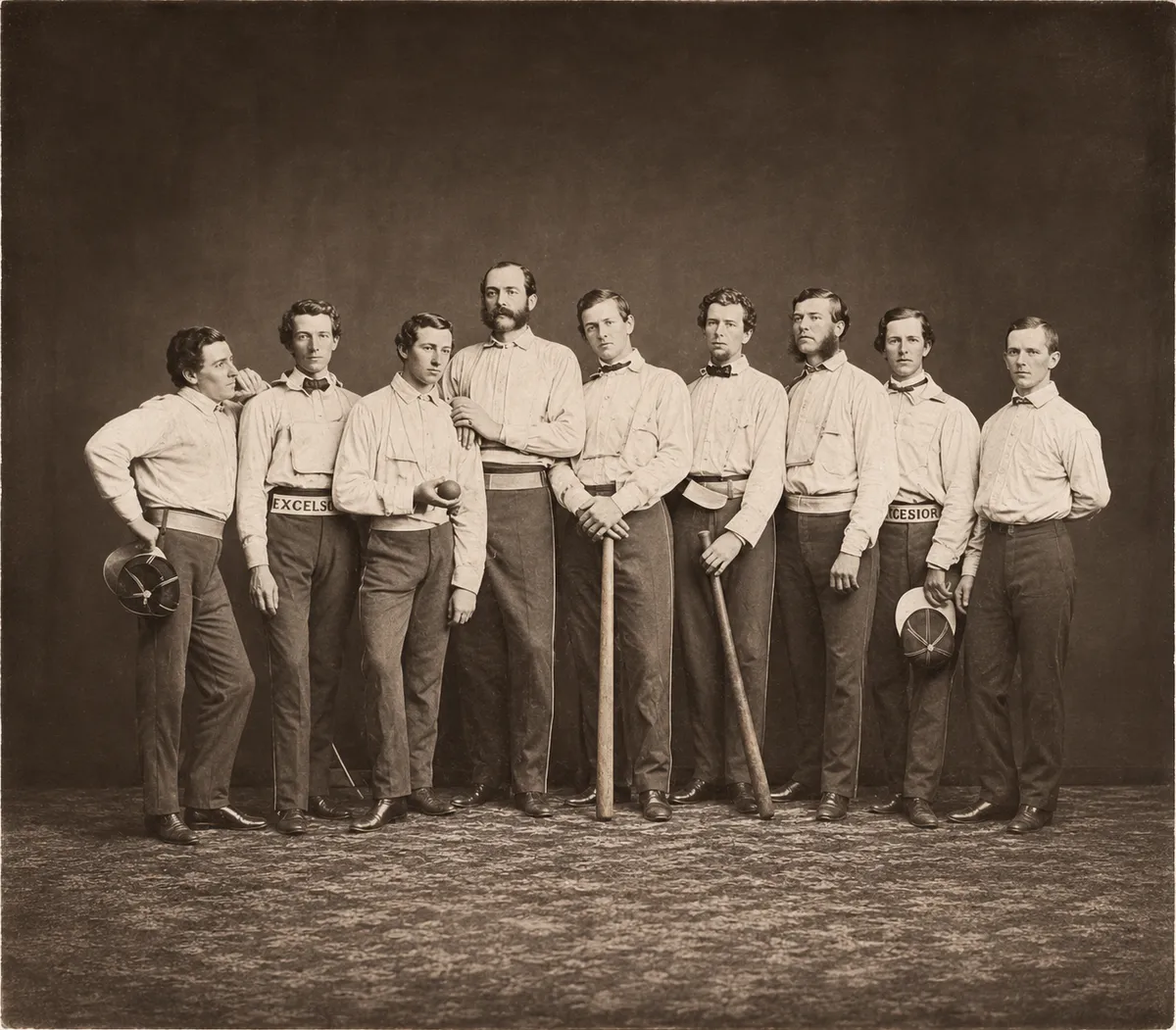
The Excelsiors are frequently credited with helping popularize an early form of the baseball cap.
Their distinctive headwear featured a rounded crown and a projecting visor, offering players protection from the sun while providing a recognizable part of the club's uniform.
The style became associated with Brooklyn baseball.
Over time, similar caps spread throughout the sport.
The modern baseball cap did not emerge fully formed from one club or one season.
Its development involved several teams, manufacturers, and changes in uniform fashion.
But the Excelsiors occupy an important place in that evolution.
They were helping establish not only how baseball was played, but how baseball players looked.
Their uniforms became part of a developing sporting culture in which teams could be recognized by their clothing as well as their names.
For a club founded before the Civil War, that was a significant contribution.
And the Excelsiors were just getting started.
The Arrival of Jim Creighton
In 1860, the Excelsiors featured a young player who would become one of the most extraordinary figures in early baseball.
James Creighton Jr.
Born in New York in 1841, Creighton was still a teenager when he began attracting attention for his remarkable ability.
He was a talented hitter.
An accomplished cricket player.
And, most importantly, a pitcher unlike almost anyone the baseball world had seen.
At a time when pitchers were generally expected to deliver hittable balls, Creighton approached the position differently.
He wanted to defeat the batter.
Using exceptional speed, accuracy, spin, and an unusual delivery, he made hitting extraordinarily difficult.
His pitches were delivered underhand, as the rules required, but his wrist action and command challenged the accepted conventions of the game.
Opposing players struggled to make solid contact.
Spectators were fascinated.
And the Excelsiors suddenly possessed a weapon that could change the outcome of a match almost by itself.
Creighton was also at the center of an important change in baseball culture.
Although the Excelsiors officially belonged to the amateur game, historians have found evidence suggesting that Creighton received compensation for playing.
The precise arrangements remain debated.
But he is widely regarded as one of baseball's earliest professional players.
Long before professional baseball was formally organized, the line between amateur competition and paid athletic talent was already beginning to blur.
Creighton stood directly on that line.
And with him on the field, the Excelsiors became one of the most formidable clubs in America.
The Battery That Changed Baseball
A great pitcher needs someone capable of catching him.
For Jim Creighton, that man was Joe Leggett.
Leggett was an accomplished catcher who possessed the skill and courage necessary to handle Creighton's unusually swift deliveries.
This was no small assignment.
Catchers of the period worked with limited protective equipment.
Modern padded mitts, masks, and chest protectors had not yet become standard.
Catching a hard-thrown baseball required considerable toughness.
Together, Creighton and Leggett formed one of the most celebrated pitcher-catcher combinations of the early game.
Their partnership demonstrated how important a dominant battery could be.
Rather than relying almost entirely on fielders to retire opposing batters, a club could use pitching to control the contest.
The change was revolutionary.
Creighton's approach helped push baseball toward the increasingly competitive relationship between pitcher and hitter that defines the modern sport.
And in 1860, the Excelsiors were ready to demonstrate their abilities far beyond Brooklyn.
The Grand Excursion of 1860
In June 1860, the Excelsiors announced an ambitious plan.
They would leave Brooklyn and travel through upstate New York, playing matches against clubs in other communities.
Today, a baseball road trip seems entirely ordinary.
In 1860, it was extraordinary.
Most organized clubs competed primarily against teams in their own city or nearby communities.
Long-distance travel was expensive.
Scheduling matches required extensive correspondence.
And the railroads and other transportation systems of the period made such journeys a substantial undertaking.
The Excelsiors decided to do it anyway.
On June 30, 1860, the club departed Brooklyn.
Their journey would take them through several New York communities, including Albany, Troy, Buffalo, and Rochester.
The trip became known as the Grand Excursion.
It is widely recognized as the first extended baseball tour of its kind.
Newspapers followed the traveling club's progress.
Local spectators gathered to watch the visitors from Brooklyn.
And opposing teams discovered just how formidable the Excelsiors could be.
The Brooklyn players demonstrated a level of coordinated play and pitching skill that impressed observers.
Creighton, in particular, attracted enormous attention.
His deliveries were faster and more difficult to hit than many opponents had previously encountered.
The Excelsiors returned home with their reputation greatly enhanced.
But the tour accomplished something larger than winning games.
It helped spread the appeal of organized baseball beyond the New York metropolitan area.
Communities that had previously known relatively little about the sport witnessed a highly skilled club in action.
The Excelsiors were not simply playing baseball.
They were helping introduce it to a broader American audience.
The Rivalry That Divided Brooklyn
No account of the Excelsiors would be complete without the Brooklyn Atlantics.
The Atlantics were among the strongest clubs in early baseball.
Their matches against the Excelsiors attracted enormous attention.
Both teams represented the competitive spirit of Brooklyn baseball.
Both possessed talented players.
And both had supporters who believed their club was the finest in the country.
In 1860, the rivalry reached a dramatic peak.
The Excelsiors and Atlantics arranged a series of matches that would help determine their relative standing.
The Excelsiors won the first meeting.
The Atlantics won the second.
That left a deciding contest.
The third match, played in August, drew a large and emotionally charged crowd.
The Excelsiors established an early lead.
But the atmosphere became increasingly hostile.
Disputes, crowd interference, and accusations of improper behavior created a situation that club officials considered dangerous.
With the contest unfinished, the Excelsiors withdrew from the field.
The match was not completed.
The controversy became one of the most famous incidents in nineteenth-century baseball.
The Atlantics retained their claim to supremacy, while Excelsior supporters believed their club had been denied the opportunity to finish the series.
There was no modern league office to settle the dispute.
No instant replay.
No standardized championship authority comparable to those of later professional baseball.
Instead, reputation, public opinion, and the sporting press helped shape how the incident was remembered.
The rivalry demonstrated how far baseball had come.
What had begun as recreation among gentlemen's clubs had become a fiercely competitive spectator sport.
And the Excelsiors were at the center of it.
Baseball's First Great Tragedy
The Excelsiors' greatest star seemed destined for a remarkable career.
But Jim Creighton's life would end before he reached his twenty-second birthday.
In October 1862, Creighton became seriously ill and died on October 18.
He was just 21 years old.
His death shocked the baseball community.
A famous story later developed that Creighton had suffered a fatal internal injury while swinging at a pitch during a game.
According to the legend, the force of his swing caused an organ to rupture.
The account became one of baseball's most frequently repeated early stories.
But modern historical research has raised serious doubts about the traditional explanation.
The exact medical circumstances of Creighton's death remain uncertain, and historians have identified evidence consistent with a ruptured inguinal hernia.
The familiar story of a fatal home-run swing should therefore be treated as legend rather than established fact.
What is beyond dispute is the impact of his death.
Creighton had become one of baseball's first national stars.
He had transformed expectations of what a pitcher could accomplish.
And his success helped accelerate the sport's movement toward more competitive pitching.
He was buried in Brooklyn's Green-Wood Cemetery, where a monument commemorates his life.
For the Excelsiors, his loss marked the end of an extraordinary chapter.
For baseball, it meant losing one of its most influential pioneers.
The Game Moves Beyond Brooklyn
The years following Creighton's death brought enormous changes to the United States.
The Civil War disrupted everyday life, including organized baseball.
Yet the game continued to spread.
Soldiers played baseball in military camps.
New clubs formed in towns and cities.
Newspapers devoted increasing attention to matches and prominent players.
The National Association of Base Ball Players expanded rapidly.
And the sport gradually moved toward openly professional competition.
The Excelsiors continued to be part of Brooklyn baseball during the 1860s, but the game's center of gravity was shifting.
Other clubs rose to prominence.
Players moved between organizations.
Competition intensified.
And the financial realities of attracting talented players became increasingly difficult to ignore.
In 1869, the Cincinnati Red Stockings became famous as an openly professional baseball team.
Two years later, the National Association of Professional Base Ball Players began play.
The era of professional league baseball had arrived.
The Excelsiors belonged to the generation that made that transformation possible.
But they would not become one of its enduring professional franchises.
What Happened to the Brooklyn Excelsiors?
By around 1870, the Excelsiors had disappeared from the leading ranks of organized baseball.
Their great rivals, the Atlantics and Eckfords, also faced the challenges of a changing sporting landscape.
The older model of amateur clubs competing for local prestige was giving way to professional teams operating in increasingly formal organizations.
The Excelsiors never made the transition into a lasting Major League club.
Their name faded.
Their playing grounds changed.
And many of their players eventually became little more than names in nineteenth-century newspaper accounts.
But the club's influence endured.
They helped popularize a recognizable style of baseball headwear.
They featured one of the first great pitcher-catcher partnerships.
They helped establish the value of dominant pitching.
They undertook a pioneering baseball tour that introduced high-level play to new audiences.
And they gave the game one of its first true superstars.
The Brooklyn Excelsiors existed before baseball had the structure, wealth, and national institutions that would later define it.
They helped create the conditions that made those developments possible.
Today, Brooklyn baseball history is often told through the Dodgers.
Ebbets Field.
Jackie Robinson.
The move to Los Angeles.
But nearly a century before those familiar chapters, another Brooklyn club was helping shape America's national pastime.
The Excelsiors.
They traveled when baseball teams rarely traveled.
They challenged the game's accepted methods.
They played before professional leagues existed.
And their young pitching star helped change baseball forever.
Some teams are remembered because they won championships.
Others are remembered because they changed the game.
The Brooklyn Excelsiors did something even more remarkable.
They helped baseball become the game we know today.
And they belong in the Archive.
EXPLORE OUR BROOKLYN EXCELSIORS COLLECTION
GHOST LEAGUE ARCHIVE
Forgotten Teams. Unforgettable Legacy.
HISTORICAL NOTE:
Ghost League Supply Co. researches each Archive entry using available historical records and sources. Because many early teams were poorly documented, dates, records, names and other details may vary between sources.
Some images and artwork appearing in the League Archive are AI-assisted historical interpretations created for illustrative purposes and should not be considered authentic photographs, official team artwork or exact historical reconstructions.